
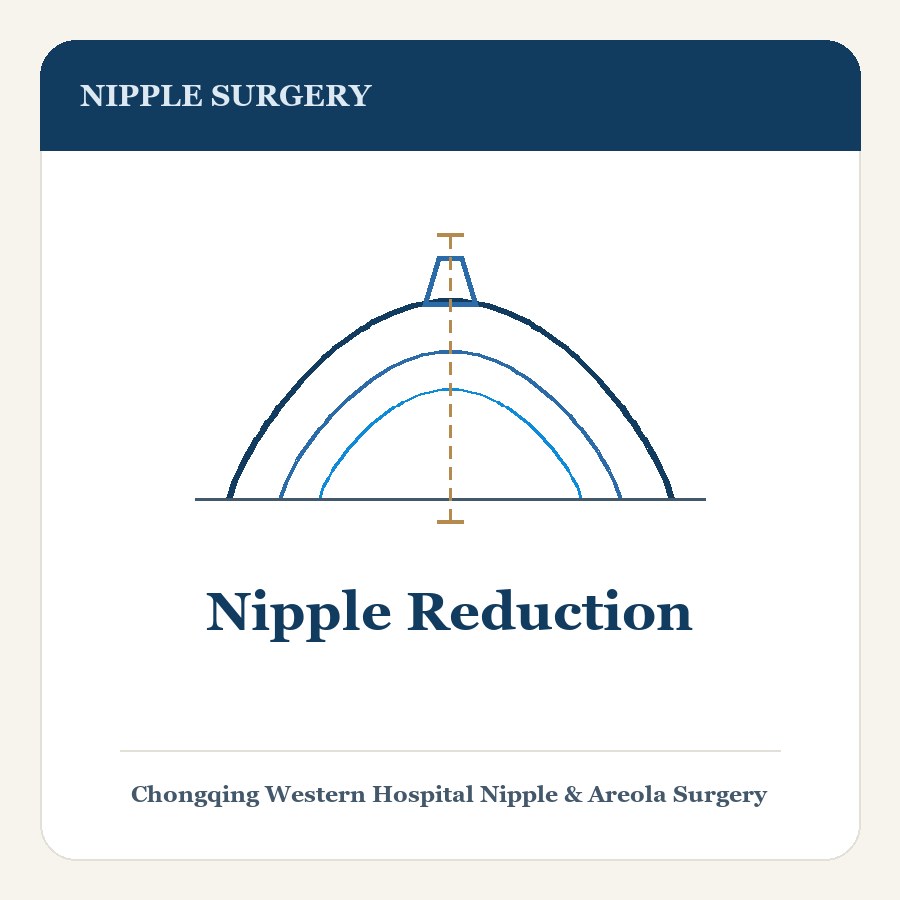
In short. Nipple reduction for a long or prominent nipple: what the operation does, the techniques available, what it costs in sensation and breastfeeding, and how durable the result is.
Key points
- Tissue removed from the nipple cannot be put back.
- A conservative first operation that leaves slightly more projection than you asked for is much easier to refine than an aggressive one that has removed too much.
- Under-correction is the safer error.
A nipple that is long, wide or persistently prominent is a common concern and one that people rarely raise with a doctor. It can cause embarrassment in clothing, discomfort under a bra or a seatbelt, and self-consciousness out of proportion to the size of the problem. Nipple reduction is a small operation that addresses it directly.
Is it the nipple, or the areola?
Assessment separates two things that are often confused. Projection is how far the nipple stands out from the areola; diameter is how wide it is, and the diameter that bothers people is frequently the areola rather than the nipple itself. A nipple that looks large may simply be sitting on a small areola. The distinction decides the operation, and getting it wrong is the most common reason for disappointment.
What the operation does
Nipple reduction removes tissue from the nipple and closes it again, either shortening the projection or narrowing the base, or both. Several techniques exist. A wedge or transverse excision takes a small block from one side of the nipple and closes the defect, shortening projection and leaving a fine scar across the nipple that usually fades well. A circumferential approach removes a ring of skin at the base to reduce height while preserving the tip. Some surgeons combine the two.
The surgery is usually performed under local anesthesia and takes under an hour. Stitches, where used, are removed at around seven to ten days.
The trade-off
Tissue removed from the nipple cannot be put back. A conservative first operation that leaves slightly more projection than you asked for is much easier to refine than an aggressive one that has removed too much. Under-correction is the safer error.
Sensation and breastfeeding
The nipple is densely innervated, and any operation on it can change sensation — usually temporarily, sometimes permanently. Most patients report altered sensitivity for a few weeks to a few months, and a small proportion report lasting reduction. Techniques that preserve the duct openings and the tissue beneath them are less likely to affect breastfeeding, but no technique guarantees it. Anyone planning to breastfeed should discuss this openly beforehand, and should expect that the operation may reduce supply.
Reasons to pause
- You plan to breastfeed in the near future and preserving supply matters more to you than the appearance of the nipple.
- You have an active infection, a recently pierced nipple, or a nipple that has recently been operated on or injured.
- You expect the change to be invisible: some scarring on the nipple is inevitable, though it usually fades to a faint line.
Recovery and long-term result
Expect about a week of tenderness, a fortnight of avoiding friction, and roughly a month before the shape is stable. Return of normal sensation may take several months. The reduction itself is durable, because nipple tissue does not grow back — though pregnancy and breastfeeding can change the nipple again, sometimes reversing part of the effect.
Nipple reduction is one of the most reliably satisfying small operations in this field, provided the assessment is honest about what is being reduced and what will be left behind.
Frequently asked questions
Am I unhappy with the nipple or with the areola?
That is the first thing assessment separates. Projection is how far the nipple stands out; diameter is how wide it is, and the diameter that bothers people is frequently the areola rather than the nipple itself.
Does nipple reduction affect breastfeeding?
It can. Techniques that preserve the duct openings and the tissue beneath them are less likely to affect it, but no technique guarantees it, and anyone planning to breastfeed should expect that the operation may reduce supply.
Is the result of nipple reduction long lasting?
The reduction itself is durable, because nipple tissue does not grow back. Pregnancy and breastfeeding can change the nipple again and sometimes reverse part of the effect, and normal sensation may take several months to return.
Risks & Limitations
- Loss of projection over time, the most characteristic long-term limitation of nipple reconstruction; a revision may be needed and revised projections can flatten again.
- Permanent or altered sensation, including numbness and hypersensitivity, which cannot be predicted for an individual patient.
- Scarring that is permanent, and may widen, thicken or become raised around the areola.
- Partial or complete graft or flap loss, which is much higher in smokers and after radiotherapy to the area.
- Infection, bleeding, or a collection of fluid under the skin that may need drainage.
- Asymmetry between the two sides; perfect symmetry is not achievable.
- Need for revision surgery or for repeat medical tattooing as pigment fades.
- Reduced or lost ability to breastfeed after techniques that divide the ducts beneath the nipple.
When to Seek Care
- A graft or flap that turns dark, purple or black — this suggests tissue that is not surviving and needs urgent review.
- Fever, or redness, warmth, pain or discharge that is spreading from the wound.
- A wound that is not healing, or is opening or discharging.
- Severe pain that your prescribed medication does not control.
- Sudden swelling, or a collection of fluid under the skin at the operative site.
References & Further Reading
- American Society of Plastic Surgeons (ASPS) — breast reconstruction and safety guidance
- International Society of Aesthetic Plastic Surgery (ISAPS)
- Cochrane Library — systematic reviews of breast reconstruction and surgical wound care
- Chinese Medical Association Plastic Surgery Branch — national specialty guidance
This page is patient education, not medical advice, and it does not cite individual studies. Discuss your own case with a qualified clinician. To arrange an assessment at Chongqing West District Hospital, see Contact & Consultation.