
In short. What happens to nipple and areola sensation after surgery: which operations are more likely to preserve it, why some loss may be permanent, and how to weigh the risk before you consent.
Key points
- Most patients notice altered sensation for weeks to months, and most of that recovers.
- Some do not recover fully.
- It is not possible before an operation to say which group you will fall into, and any surgeon who offers certainty is overstating what is known.
Sensation is the part of nipple-areola surgery that patients ask about least and regret most. It is also the part surgeons find hardest to predict. This guide sets out what is known, and where the honest uncertainty lies.
The nerve supply
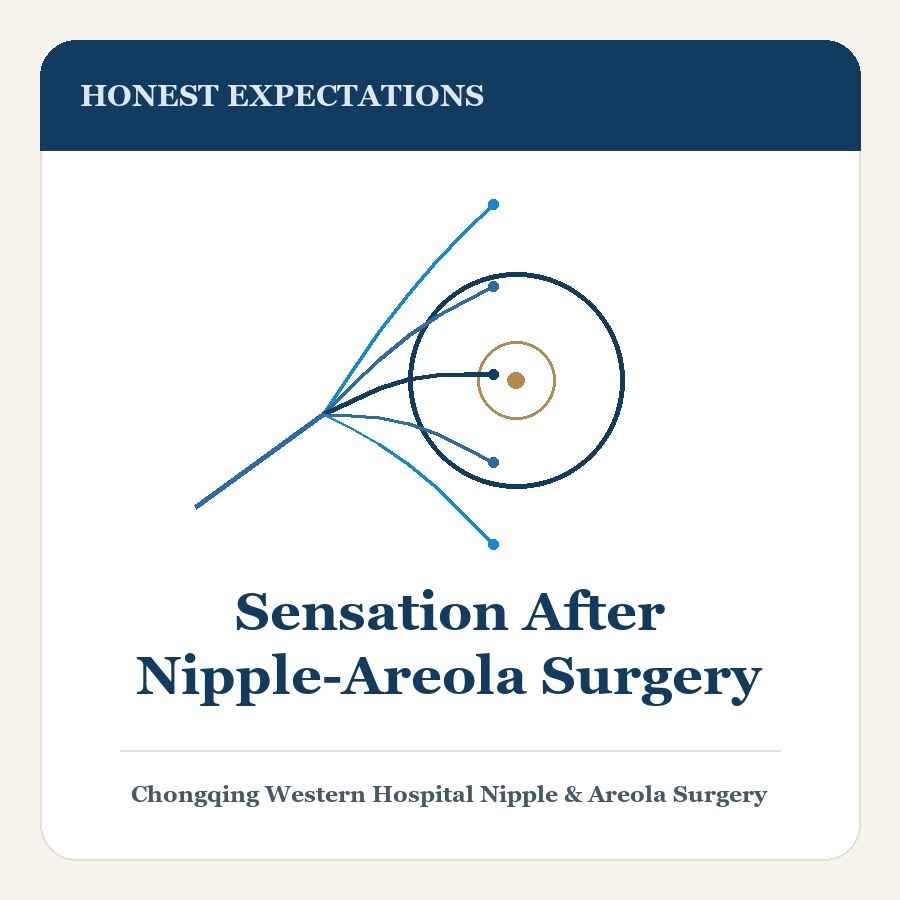
The nipple-areola complex is one of the most densely innervated areas of the body. Its sensation arrives mainly through branches of the fourth intercostal nerve, approached from the outer side of the breast, with contributions from the third and fifth. The fibres travel through the breast tissue and reach the skin from below, which is why the direction and depth of a surgical approach matter more than the length of the scar it leaves.
Nerves do not tolerate being cut and re-sutured the way blood vessels do. A divided nerve can regrow, but regrowth is slow — roughly a millimetre a day — and it is often incomplete or misdirected, ending in altered rather than normal feeling.
Which operations are riskier
Operations that divide the tissue directly beneath the nipple are the most likely to affect sensation. Duct division for a severe inverted nipple, a full circumareolar incision, and techniques that carry the complex on a narrow pedicle carry a higher risk. Operations that work only at the edge of the areola usually carry less.
Reconstruction after mastectomy is a different category altogether. When the nipple-areola complex has been removed, the tissue that carried its nerves has gone with it. A reconstructed nipple is not sensate in the way the original was, and a skin graft has no sensation of its own until nerves grow into it from the surrounding skin — incompletely, and over years.
Temporary and permanent
Most patients notice altered sensation for weeks to months, and most of that recovers. Some do not recover fully. It is not possible before an operation to say which group you will fall into, and any surgeon who offers certainty is overstating what is known.
What recovery usually looks like
In the first weeks the nipple and areola commonly feel numb, hypersensitive or oddly altered — sometimes all three at once. Tingling and shooting sensations are normal while nerves settle. Improvement is greatest in the first six months and continues slowly for up to a year. Sensation that has not returned by around eighteen months is unlikely to return fully.
Altered sensation includes hypersensitivity, where even light touch is uncomfortable, as well as reduced sensation. Both are reported, and hypersensitivity often settles more completely than numbness.
What to weigh before consenting
- Loss of sensation may be permanent, and no technique can guarantee that it will not be.
- The risk is higher with operations that divide tissue beneath the nipple and lower with operations confined to the areola edge.
- Nipple sensation matters to sexual function for many people; if it matters to you, say so before the plan is fixed, because it may change which operation is offered.
Talking about it
Raise the question at the consultation rather than after the operation. Ask which step of the proposed technique puts sensation at risk, and what the alternative would cost in correction or recurrence. A surgeon who can answer that precisely has already thought carefully about it.
Frequently asked questions
How long does nipple sensation take to recover after surgery?
Improvement is greatest in the first six months and continues slowly for up to a year. Sensation that has not returned by around eighteen months is unlikely to return fully, and numbness, hypersensitivity or altered feeling can all occur.
Which operations put nipple sensation most at risk?
Those that divide the tissue directly beneath the nipple, such as duct division for a severe inverted nipple, a full circumareolar incision, or techniques carrying the complex on a narrow pedicle. Operations at the areola edge carry less risk.
Does a reconstructed nipple have sensation?
Not in the way the original did. When the complex has been removed, the tissue carrying its nerves has gone with it. A skin graft has no sensation of its own until nerves grow into it from the surrounding skin, incompletely and over years.
Risks & Limitations
- Loss of projection over time, the most characteristic long-term limitation of nipple reconstruction; a revision may be needed and revised projections can flatten again.
- Permanent or altered sensation, including numbness and hypersensitivity, which cannot be predicted for an individual patient.
- Scarring that is permanent, and may widen, thicken or become raised around the areola.
- Partial or complete graft or flap loss, which is much higher in smokers and after radiotherapy to the area.
- Infection, bleeding, or a collection of fluid under the skin that may need drainage.
- Asymmetry between the two sides; perfect symmetry is not achievable.
- Need for revision surgery or for repeat medical tattooing as pigment fades.
- Reduced or lost ability to breastfeed after techniques that divide the ducts beneath the nipple.
When to Seek Care
- A graft or flap that turns dark, purple or black — this suggests tissue that is not surviving and needs urgent review.
- Fever, or redness, warmth, pain or discharge that is spreading from the wound.
- A wound that is not healing, or is opening or discharging.
- Severe pain that your prescribed medication does not control.
- Sudden swelling, or a collection of fluid under the skin at the operative site.
References & Further Reading
- American Society of Plastic Surgeons (ASPS) — breast reconstruction and safety guidance
- International Society of Aesthetic Plastic Surgery (ISAPS)
- Cochrane Library — systematic reviews of breast reconstruction and surgical wound care
- Chinese Medical Association Plastic Surgery Branch — national specialty guidance
This page is patient education, not medical advice, and it does not cite individual studies. Discuss your own case with a qualified clinician. To arrange an assessment at Chongqing West District Hospital, see Contact & Consultation.