
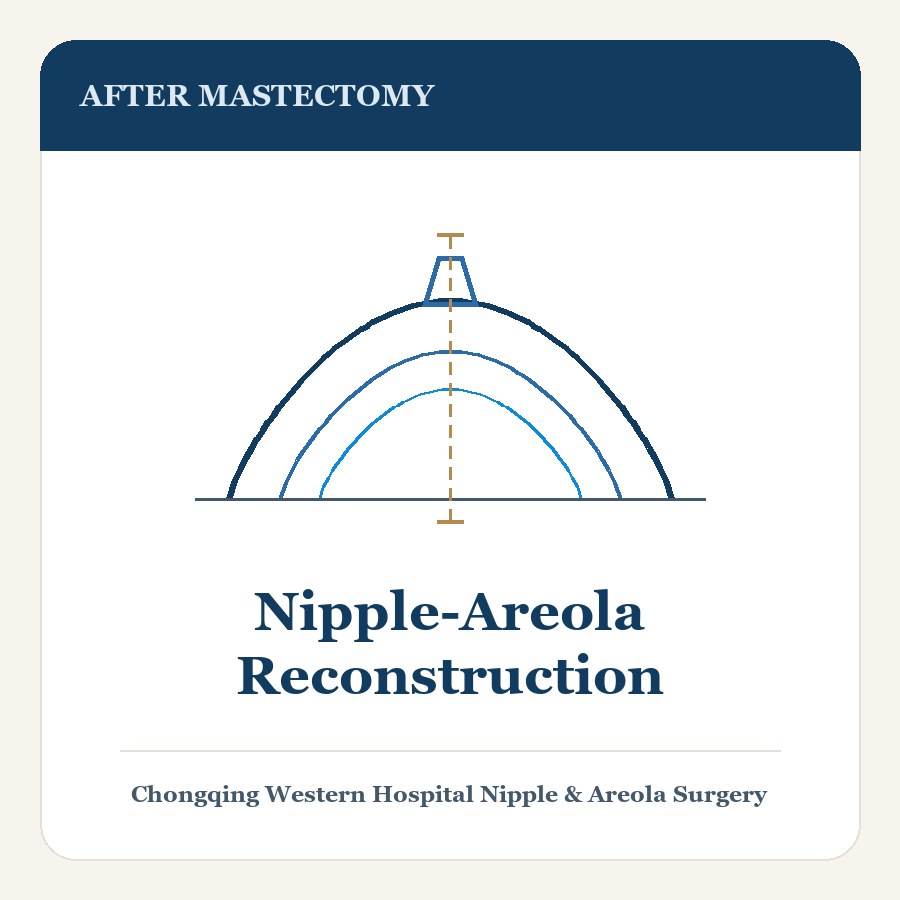
In short. How a nipple and areola are rebuilt after mastectomy: when reconstruction should happen relative to the breast mound, the techniques that create projection, and why the result is an appearance rather than a function.
Key points
- A reconstructed nipple is raised by rearranging tissue that is already there.
- That tissue has no duct, no muscle and no erectile response — which is why projection softens and flattens over the years, and why a touch-up is common.
Nipple-areola reconstruction rebuilds the pigmented centre of the breast after mastectomy. It is the last stage of breast reconstruction, and often the stage that turns a reconstructed mound into something that reads as a breast at a glance. It is worth being clear at the outset: this operation creates the appearance of a nipple. It does not restore a functioning one.
Timing relative to the breast reconstruction
Reconstruction is staged deliberately. The breast mound must be complete and settled first — usually three to six months after the final shaping operation, once swelling has resolved and the skin has softened. Building a nipple onto a mound that is still changing means the position will drift, and a nipple in the wrong place is a conspicuous problem that is awkward to undo.
If adjuvant radiotherapy is planned, the schedule changes. Radiation can shrink and distort a reconstructed nipple, so most teams wait at least six months after treatment finishes, sometimes longer. Patients who still need further breast surgery — for symmetry on the opposite side, for example — are usually advised to complete that first, so the complex sits on a breast that has reached its final shape.
Creating projection
Projection is the technical challenge, and there are three broad routes. A local flap uses skin from the reconstructed mound, folded or rolled on itself to make a raised centre. It brings its own blood supply and heals reliably, and the scar it leaves is usually hidden within the new areola. A skin graft takes a thin sheet of skin — often from the groin, the inner thigh or the opposite areola — to resurface a de-epithelialised area. Grafts suit the areola disc well and can add pigment.
Many surgeons combine the two: a small flap for the nipple and a graft for the areola. A third option uses a small volume of filler, but this is less predictable and is more often used for touch-up than for reconstruction.
Projection is borrowed, not built
A reconstructed nipple is raised by rearranging tissue that is already there. That tissue has no duct, no muscle and no erectile response — which is why projection softens and flattens over the years, and why a touch-up is common.
The areola
The areola is treated as two separate problems: surface and colour. Surface can be improved with a graft or by recruiting local skin. Colour is almost always addressed with medical tattooing, which is the next guide in this section.
Honest limits
- The result is the appearance of a nipple, not a functional one: it will not respond to stimulation or recover the original sensation.
- Projection commonly flattens over time, and a revision or repeat tattooing is often needed to maintain the result.
- Graft and flap tissue can fail, particularly in smokers or after radiotherapy, and loss may require further surgery.
What to expect
The operation is usually a day case or a single night in hospital, under local or general anesthesia. Dressings protect a graft for the first week, and the new nipple is kept clear of pressure for several weeks. The shape settles over three to six months.
Done well, in the right order and at the right time, this is a small operation with a disproportionate effect on how a woman feels about her reconstruction.
Frequently asked questions
Does a reconstructed nipple work like the original?
No. It creates the appearance of a nipple, not a functional one. It has no duct, no muscle and no erectile response, so it will not respond to stimulation or recover the original sensation, and projection tends to soften and flatten over the years.
Why must the breast mound settle before the nipple is rebuilt?
Because building a nipple onto a mound that is still changing means the position will drift, and a nipple in the wrong place is conspicuous and awkward to undo. Most teams wait until swelling has resolved and the skin has softened.
How is projection created in nipple reconstruction?
Mainly by rearranging tissue that is already there. A local flap uses skin from the reconstructed mound, folded or rolled to make a raised centre, and this is often combined with a graft to resurface the areola.
Risks & Limitations
- Loss of projection over time, the most characteristic long-term limitation of nipple reconstruction; a revision may be needed and revised projections can flatten again.
- Permanent or altered sensation, including numbness and hypersensitivity, which cannot be predicted for an individual patient.
- Scarring that is permanent, and may widen, thicken or become raised around the areola.
- Partial or complete graft or flap loss, which is much higher in smokers and after radiotherapy to the area.
- Infection, bleeding, or a collection of fluid under the skin that may need drainage.
- Asymmetry between the two sides; perfect symmetry is not achievable.
- Need for revision surgery or for repeat medical tattooing as pigment fades.
- Reduced or lost ability to breastfeed after techniques that divide the ducts beneath the nipple.
When to Seek Care
- A graft or flap that turns dark, purple or black — this suggests tissue that is not surviving and needs urgent review.
- Fever, or redness, warmth, pain or discharge that is spreading from the wound.
- A wound that is not healing, or is opening or discharging.
- Severe pain that your prescribed medication does not control.
- Sudden swelling, or a collection of fluid under the skin at the operative site.
References & Further Reading
- American Society of Plastic Surgeons (ASPS) — breast reconstruction and safety guidance
- International Society of Aesthetic Plastic Surgery (ISAPS)
- Cochrane Library — systematic reviews of breast reconstruction and surgical wound care
- Chinese Medical Association Plastic Surgery Branch — national specialty guidance
This page is patient education, not medical advice, and it does not cite individual studies. Discuss your own case with a qualified clinician. To arrange an assessment at Chongqing West District Hospital, see Contact & Consultation.