
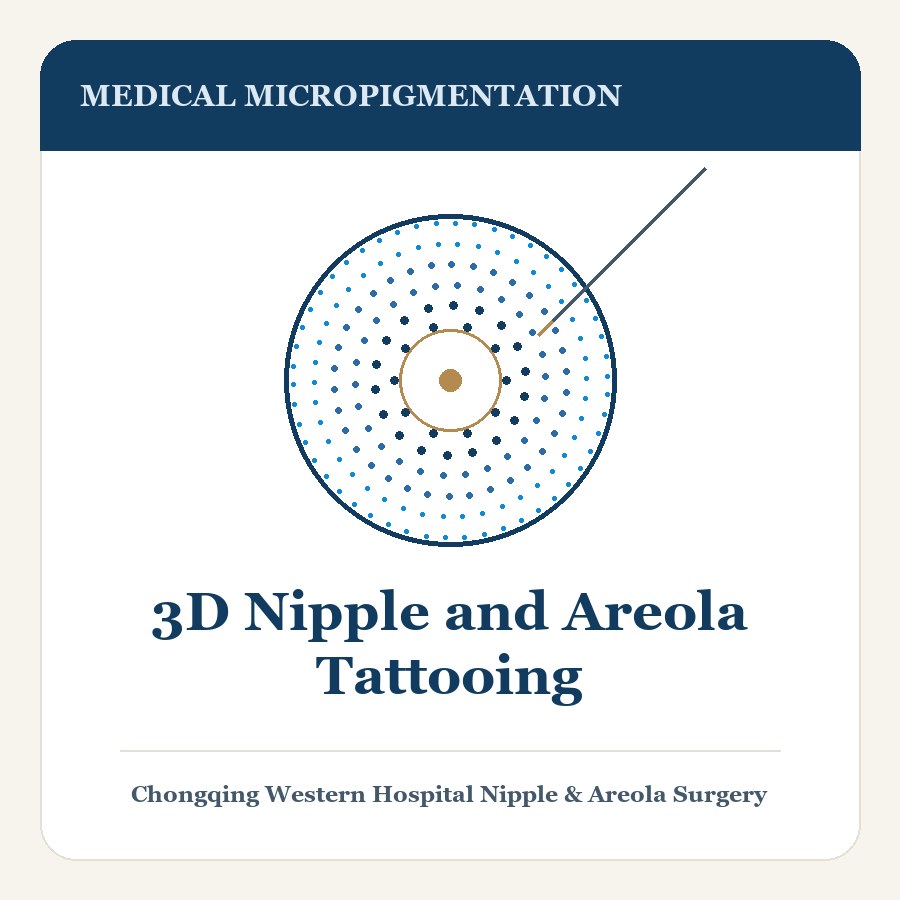
In short. Medical micropigmentation of the nipple and areola: what it can realistically achieve, how long it lasts, why it usually needs repeating, and how it fits with surgical reconstruction.
Key points
- Tattooing changes colour and creates an illusion of depth.
- It cannot create projection, cannot change the shape of a scarred areola, and cannot restore sensation.
- Where projection is missing, surgery comes first and tattooing finishes the job.
Medical tattooing, or micropigmentation, places pigment into the upper layer of the skin to recreate the colour and, to a degree, the shading of an areola. In nipple-areola practice it is used in three situations: after surgical reconstruction, where the new nipple has little or no colour of its own; after surgery that has left the areola pale, patchy or crossed by scar; and where the complex is intact but the colour has faded with age or earlier treatment.
What it can achieve
A skilled practitioner can match the natural colour of the opposite areola, rebuild a circular or oval boundary where the edge has been lost, and add subtle shading that gives an illusion of projection — the “3D” in the name refers to that shading rather than to any actual depth. Where the nipple itself has been rebuilt, tattooing can darken it so that it reads as distinct from the areola.
The effect is genuinely significant. For many women, colour is the step that makes a reconstruction look complete, and it is often described as the point at which they stopped avoiding mirrors. That is worth stating plainly, because tattooing is sometimes treated as a cosmetic afterthought when in fact it carries much of the result.
Shading, not surgery
Tattooing changes colour and creates an illusion of depth. It cannot create projection, cannot change the shape of a scarred areola, and cannot restore sensation. Where projection is missing, surgery comes first and tattooing finishes the job.
How it is done
Pigment is applied with a fine needle over one or more sessions, usually starting a few months after surgery so that scars have settled and the colour is stable. Most practitioners begin with a lighter tone and build toward the target over two or three sessions, because pigment takes unpredictably in scarred or grafted skin.
Discomfort is usually described as moderate, and a topical anesthetic is often enough. After each session the area is tender and lightly scabbed for about a week, and it must be kept clean and out of strong sun while it settles.
What you should know before booking
- It is not permanent. Fading begins within a few years, and most people need a refresh every two to five years.
- Results on scarred or grafted skin are less predictable than on intact skin, and a single session rarely achieves the final result.
- Pigment can be placed too deeply, too darkly or asymmetrically, and correcting an over-tattooed areola is difficult.
Who should do it
Look for a practitioner who works with reconstructed breasts regularly, who will match pigment to your own skin under proper light, and who offers a review appointment as a matter of routine. Ask to see results on skin similar to yours, and ask what happens if the colour is not right. Tattooing an areola is a small procedure with a small margin for error, and the person holding the needle matters more than the machine.
It is usually the final step in reconstruction. It is also the step most easily repeated if it fades — which, unlike a surgical revision, is a relatively gentle thing to redo.
Frequently asked questions
Is areola tattooing permanent?
No. Fading begins within a few years, and most people need a refresh every two to five years. That is also its advantage: unlike a surgical revision, repeating it is a relatively gentle thing to do.
Can tattooing replace a missing nipple?
No. Tattooing changes colour and creates an illusion of depth, which is what the 3D refers to. It cannot create projection, change the shape of a scarred areola or restore sensation, so where projection is missing surgery comes first.
Why does tattooing usually take more than one session?
Because pigment takes unpredictably in scarred or grafted skin. Most practitioners begin with a lighter tone and build toward the target over two or three sessions, starting a few months after surgery once scars have settled.
Risks & Limitations
- Loss of projection over time, the most characteristic long-term limitation of nipple reconstruction; a revision may be needed and revised projections can flatten again.
- Permanent or altered sensation, including numbness and hypersensitivity, which cannot be predicted for an individual patient.
- Scarring that is permanent, and may widen, thicken or become raised around the areola.
- Partial or complete graft or flap loss, which is much higher in smokers and after radiotherapy to the area.
- Infection, bleeding, or a collection of fluid under the skin that may need drainage.
- Asymmetry between the two sides; perfect symmetry is not achievable.
- Need for revision surgery or for repeat medical tattooing as pigment fades.
- Reduced or lost ability to breastfeed after techniques that divide the ducts beneath the nipple.
When to Seek Care
- A graft or flap that turns dark, purple or black — this suggests tissue that is not surviving and needs urgent review.
- Fever, or redness, warmth, pain or discharge that is spreading from the wound.
- A wound that is not healing, or is opening or discharging.
- Severe pain that your prescribed medication does not control.
- Sudden swelling, or a collection of fluid under the skin at the operative site.
References & Further Reading
- American Society of Plastic Surgeons (ASPS) — breast reconstruction and safety guidance
- International Society of Aesthetic Plastic Surgery (ISAPS)
- Cochrane Library — systematic reviews of breast reconstruction and surgical wound care
- Chinese Medical Association Plastic Surgery Branch — national specialty guidance
This page is patient education, not medical advice, and it does not cite individual studies. Discuss your own case with a qualified clinician. To arrange an assessment at Chongqing West District Hospital, see Contact & Consultation.