
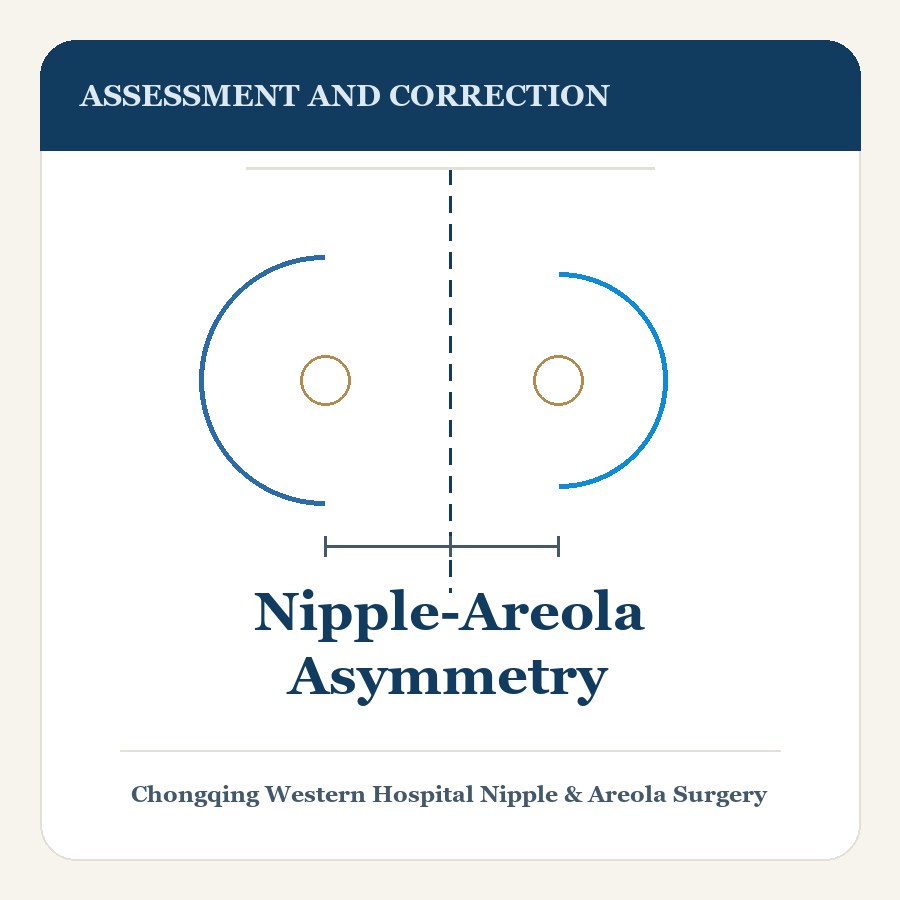
In short. Asymmetry of the nipple and areola: how the two sides are compared, which differences are entirely normal, and which can realistically be improved by surgery.
Key points
- When the two sides differ, surgery usually modifies one side to match the other.
- Deciding which side is the reference is a real decision and should be made with your surgeon rather than assumed — sometimes both sides are adjusted so that they meet in the middle.
No one is symmetrical, and the nipple-areola complex is no exception. Differences in size, shape, position, projection and colour between the two sides are the norm rather than the exception, and most people have never measured theirs. Surgery does not aim for perfect symmetry; it aims to reduce a difference that is noticeable enough to bother you.
How asymmetry is assessed
Assessment is systematic, because “they do not match” can mean several quite different things. Diameter is measured in millimetres on each side. Projection is compared with the nipple at rest and again with the nipple contracted, since some differences appear only on stimulation. Position is judged relative to the breast mound rather than to the chest wall — the relevant question is where the complex sits on the breast, not where it sits in space. Shape covers the outline of the areola and the profile of the nipple. Colour completes the picture, and a difference in pigment between the two sides is common and often the easiest thing to correct.
Which side do you match?
When the two sides differ, surgery usually modifies one side to match the other. Deciding which side is the reference is a real decision and should be made with your surgeon rather than assumed — sometimes both sides are adjusted so that they meet in the middle.
What can be corrected
A size difference in the areola can be reduced by taking a ring of skin from the larger side. A nipple that is longer on one side can be shortened to match the other. Positional differences are the hardest to correct in isolation, because moving a complex means moving the skin around it; they are usually addressed as part of a breast lift or a reduction. Colour differences respond well to medical tattooing, which can darken the paler side to match.
Where the asymmetry comes from the breast mound rather than from the complex, correcting the complex alone will not solve it. A noticeably different breast volume has to be addressed at the level of the breast, and the nipple-areola work follows.
When asymmetry is not cosmetic
A nipple that has recently changed — newly inverted, newly retracted, newly discharging, or with a new area of scaling or crusting on the areola — should be assessed as a medical problem before any aesthetic correction is considered. This is uncommon, but it is precisely why a proper examination comes before a surgical plan.
Realistic expectations
- Surgery can reduce a difference but will not eliminate it; every pair of breasts has some asymmetry.
- Only the nipple-areola complex is corrected, so any difference in the breast mound is unchanged unless it is addressed separately.
- Healing is not perfectly predictable, and a small revision may be needed to fine-tune the match.
Planning
Most corrections are small operations performed under local anesthesia, sometimes on both sides in one session. Where the asymmetry is part of a larger breast problem, the plan is staged so that the breast shape settles first and the complex is refined last. Photographs taken before and after are the only reliable way to judge how much has actually changed.
Asymmetry correction is rarely dramatic and rarely noticeable from the outside — which is exactly the point of it.
Frequently asked questions
Is it normal for the two sides not to match?
Yes. Differences in size, shape, position, projection and colour between the two sides are the norm rather than the exception, and most people have never measured theirs. Surgery aims to reduce a difference, not to achieve perfect symmetry.
Which side is used as the reference when correcting asymmetry?
That is a real decision and should be made with your surgeon rather than assumed. Usually one side is modified to match the other, but sometimes both sides are adjusted so that they meet in the middle.
Can a difference in the nipple be corrected without touching the breast?
Only when the difference lies in the complex itself. Where the asymmetry comes from the breast mound, correcting the complex alone will not solve it, and the difference in breast volume has to be addressed at the level of the breast.
Risks & Limitations
- Loss of projection over time, the most characteristic long-term limitation of nipple reconstruction; a revision may be needed and revised projections can flatten again.
- Permanent or altered sensation, including numbness and hypersensitivity, which cannot be predicted for an individual patient.
- Scarring that is permanent, and may widen, thicken or become raised around the areola.
- Partial or complete graft or flap loss, which is much higher in smokers and after radiotherapy to the area.
- Infection, bleeding, or a collection of fluid under the skin that may need drainage.
- Asymmetry between the two sides; perfect symmetry is not achievable.
- Need for revision surgery or for repeat medical tattooing as pigment fades.
- Reduced or lost ability to breastfeed after techniques that divide the ducts beneath the nipple.
When to Seek Care
- A graft or flap that turns dark, purple or black — this suggests tissue that is not surviving and needs urgent review.
- Fever, or redness, warmth, pain or discharge that is spreading from the wound.
- A wound that is not healing, or is opening or discharging.
- Severe pain that your prescribed medication does not control.
- Sudden swelling, or a collection of fluid under the skin at the operative site.
References & Further Reading
- American Society of Plastic Surgeons (ASPS) — breast reconstruction and safety guidance
- International Society of Aesthetic Plastic Surgery (ISAPS)
- Cochrane Library — systematic reviews of breast reconstruction and surgical wound care
- Chinese Medical Association Plastic Surgery Branch — national specialty guidance
This page is patient education, not medical advice, and it does not cite individual studies. Discuss your own case with a qualified clinician. To arrange an assessment at Chongqing West District Hospital, see Contact & Consultation.