
In short. Inverted nipples explained: the three grades, why the duct-preserving technique matters if you plan to breastfeed, the real risk of recurrence, and what correction can and cannot achieve.
Key points
- Grade 1 and grade 2 nipples can usually be corrected with a technique that keeps the ducts intact, preserving the possibility of breastfeeding.
- Grade 3 often requires dividing the ducts, which ends milk supply from that breast.
- The grade should decide the operation, not the other way around.
An inverted nipple sits below the surface of the areola rather than projecting from it. It is common — reported in roughly one in ten women — and is usually a congenital variation caused by short ducts or tight connective tissue tethering the nipple inward. It is not a disease, and on its own it does not indicate anything wrong with the breast.
The grades
Classification is practical rather than academic, because the grade predicts both the difficulty of correction and the risk to breastfeeding. A grade 1 nipple can be pulled out easily and stays out, with minimal fibrosis underneath. A grade 2 nipple can be pulled out but retracts again when released; the ducts are shortened but not severely. A grade 3 nipple cannot be pulled out at all, and the fibrosis is marked. Milk ducts and breastfeeding are most affected in grade 3 and least affected in grade 1.
Why the grade matters
Grade 1 and grade 2 nipples can usually be corrected with a technique that keeps the ducts intact, preserving the possibility of breastfeeding. Grade 3 often requires dividing the ducts, which ends milk supply from that breast. The grade should decide the operation, not the other way around.
The duct-preserving technique
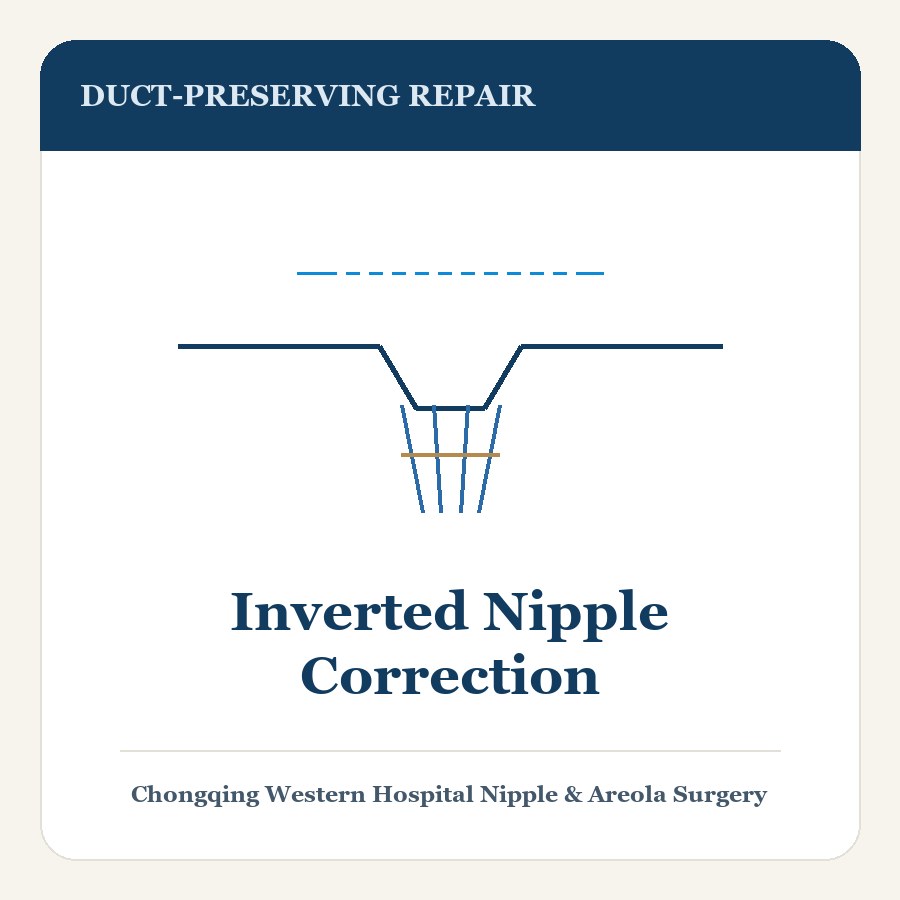
Duct-preserving correction releases the fibrous bands that hold the nipple down while leaving the ducts and most of the sensory supply intact. The surgeon works through a small incision at the base of the nipple, freeing the tethering tissue and, where needed, adding a small supporting structure to hold the nipple out. Because the ducts are preserved, breastfeeding remains possible — not guaranteed, but possible.
Where the inversion is severe, or where the ducts themselves are the cause, the ducts are divided instead. This gives a more reliable correction and a lower recurrence rate, at the cost of milk supply from that breast.
Recurrence
Recurrence is the main long-term issue, and it is why follow-up matters. Rates vary widely with grade and technique, from under one in ten after duct division to considerably higher after conservative release in severe cases. If a nipple re-inverts it usually does so within the first year, and a second operation is often more definitive than the first because the surgeon knows exactly where the tethering lay.
Before you book
- A newly inverted nipple — especially one that was previously normal — needs medical assessment before any cosmetic correction, because a sudden change can have another cause.
- Recurrence is a real possibility, particularly in the higher grades, and a repeat operation may be needed.
- Sensation can change and breastfeeding may be reduced or lost, and neither outcome can be guaranteed.
Recovery
Expect swelling and tenderness for one to two weeks, and a support dressing to hold the nipple outward during the early weeks of healing. Most people return to desk work within a few days. Friction is avoided for about a month, and the final result is judged at six months.
Correction is generally durable and well tolerated, and for many patients the relief of a long-standing concern is out of proportion to the size of the operation.
Frequently asked questions
My nipple has newly inverted. Is that always harmless?
No, and it should be assessed before any cosmetic correction. An inverted nipple that was previously normal, or one that is newly retracting or discharging, can have another cause and needs a medical examination first.
Can an inverted nipple be corrected without losing breastfeeding?
Often, if the grade allows. Grades 1 and 2 can usually be treated with a duct-preserving technique that releases the fibrous bands holding the nipple down while leaving the ducts and most sensory supply intact.
How likely is the nipple to invert again after correction?
Recurrence is the main long-term issue, and rates vary widely with grade and technique, from under one in ten after duct division to considerably higher after conservative release in severe cases. If it happens, it is usually within the first year.
Risks & Limitations
- Loss of projection over time, the most characteristic long-term limitation of nipple reconstruction; a revision may be needed and revised projections can flatten again.
- Permanent or altered sensation, including numbness and hypersensitivity, which cannot be predicted for an individual patient.
- Scarring that is permanent, and may widen, thicken or become raised around the areola.
- Partial or complete graft or flap loss, which is much higher in smokers and after radiotherapy to the area.
- Infection, bleeding, or a collection of fluid under the skin that may need drainage.
- Asymmetry between the two sides; perfect symmetry is not achievable.
- Need for revision surgery or for repeat medical tattooing as pigment fades.
- Reduced or lost ability to breastfeed after techniques that divide the ducts beneath the nipple.
When to Seek Care
- A graft or flap that turns dark, purple or black — this suggests tissue that is not surviving and needs urgent review.
- Fever, or redness, warmth, pain or discharge that is spreading from the wound.
- A wound that is not healing, or is opening or discharging.
- Severe pain that your prescribed medication does not control.
- Sudden swelling, or a collection of fluid under the skin at the operative site.
References & Further Reading
- American Society of Plastic Surgeons (ASPS) — breast reconstruction and safety guidance
- International Society of Aesthetic Plastic Surgery (ISAPS)
- Cochrane Library — systematic reviews of breast reconstruction and surgical wound care
- Chinese Medical Association Plastic Surgery Branch — national specialty guidance
This page is patient education, not medical advice, and it does not cite individual studies. Discuss your own case with a qualified clinician. To arrange an assessment at Chongqing West District Hospital, see Contact & Consultation.